When Loss leads to Action: Susie’s Inspiring Journey
by Meenal Shrivastava
Among the many wonders of the Salish Sea, the Southern Resident Killer Whales (SRKW) are the most iconic species. With only 73-75 individuals remaining, they are also Canada’s most endangered marine mammals.
Culturally, Orcas are profoundly significant for the First Nations peoples of the Pacific Northwest representing power, strength, family, protection, and transformation. Ecologically, they are a keystone species vital to the health of the entire ecosystem
For Susie Washington-Smyth, conserving the orca habitat has been both a professional and a personal journey of growth and community building. A long-time resident of Saturna Island, Susie has had a professional career working for industry, governments and agencies to advance environmental concerns. After her partner’s demise in 2019, while she was struggling with her sense of direction, a good friend told Susie, “Don’t hide, do something. Something that’s important to you.”
This was also the time when the Trans Mountain Expansion (TMX) project was approved, and Transport Canada had announced Interim Sanctuary Zones (ISZs) to protect the endangered SRKW. The ISZs, now called Vessel Restricted Zones, banned vessels, fishing and all water activity in the critical habitat of SRKW, which included Tumbo Channel. Susie’s property is about halfway up Tumbo Channel, and she frequently witnessed Orcas in the channel from this idyllic location.
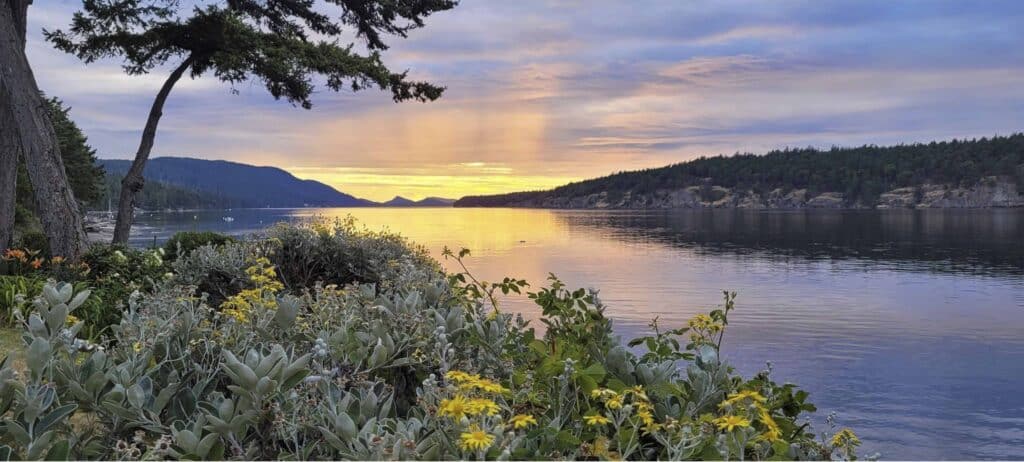
Susie remembers, “I realized that first year that the sanctuary was more than just in Boundary Pass, which is the area from where Harrow Strait comes from Pender to where Georgia Strait starts at the east end of Saturna. And it’s also, of course, the busiest commercial vessel traffic area in Canada and the second busiest on the West Coast after Los Angeles. It was not just a travel corridor for the southern residents, but an important foraging area.”
So, Susie showed up at the Transport Canada public meeting on Saturna and questioned the lack of substance in the measures and their use of only seasonal data to make decisions. Dissatisfied with their response, Susie asked the superintendent of the Gulf Islands National Park to help her organize a workshop involving fishers, tourism interests, First Nations, residents from Saturna and Pender, as well as officials from the federal and regional governments. From there on, it grew into an impressive multilayered collaboration with Simon Fraser University, Saturna Island Marine Research and Education Society (SIMRES) and the departments of Transport Canada, Fisheries and Oceans, and Parks Canada.
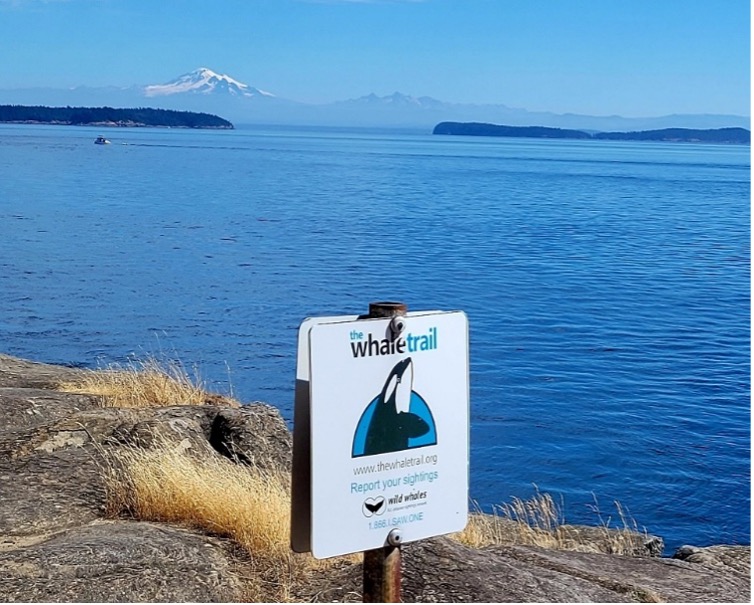
Using her extensive knowledge of adaptive environmental management and community organizing, Susie has been leading a collection of volunteer citizen scientists who help monitor and gather field data. All their sightings are verified by researchers, by photographs, and by other organizations. Their network has now expanded beyond Saturna to include Pender, Galiano, and Maine islands.Susie coordinates the Southern Gulf Islands Whale Sighting Network (SGIWSN), which also partners with the W̱SÁNEĆ Marine Guardians, and the Cetus Straitwatch on Vancouver Island. They are also part of the Whale Trail which advocates land-based whale watching.
Recently, SGIWSN and SIMRES collaborated on Critical Distance, a powerful immersive augmented reality show that brings us face to face with the challenges faced by the orcas. We see and hear what Kiki, a member of the J-Pod, must navigate in her home that is filled with wonders and dangers, where noise is rising and the food supply is dwindling. This exhibition will run until July 6 at the Royal BC Museum.
Susie has been a catalyst in transforming concerned citizens into a dedicated group of volunteers who are collecting robust data, providing baseline, and are now being asked for input on policy and regulation related to conservation efforts in the Salish Sea.
As an additional reward, these efforts have built a supportive community of people who are kind and committed to protecting the wonders of nature in the region. Beyond sustaining collaboration, Susie’s has created connections that have led to enduring friendships.
Orcas are referred to as an umbrella species, which means that anything we do to protect them is going to impact, and have cascading effects on, the rest of the ecosystem. Susie’s story proves it.
Would you like to help the SRKW?
Join: https://simres.ca/
Watch: SIMRES SEATALKS – YouTube
Visit: Critical Distance: Critical Distance | Royal BC Museum