Clean Air is Important for Health: Purple Air Monitors in North Saanich
by Jillian Buriak
Check your air quality in real time, 24/7!
Turn on the tap and drink from it. We don’t even have to think twice about the safety of our water, even though it has made quite the trek from the Sooke Lake Reservoir, 75-85 km from North Saanich. The cost is so low that we can even irrigate ornamental lawns and gardens with this same water source. There has been a rapidly growing understanding that the quality of air we breathe also has a critical impact on health, in the context of air pollution and transmission of respiratory illnesses. The Lancet Commission on Pollution and Health has identified that particulate pollution, small particles emitted by incomplete combustion (burning), is the worst form of pollution for human health. Recent data links exposure to this type of pollution with dementia: “reduced exposure to pollution could reduce dementia rates and stricter air quality standards would likely provide substantial health, social, and economic benefits.”
While many days we have impeccable air quality here in North Saanich, think blue skies and clean air after a rain, others are not so good due to wildfires and local burning (green waste, wood burning stoves operating with meteorological inversion layer). On occasion, the poor air quality here can rival or exceed that of a large urban centre. You can easily monitor air quality in North Saanich by checking the Purple Air map:
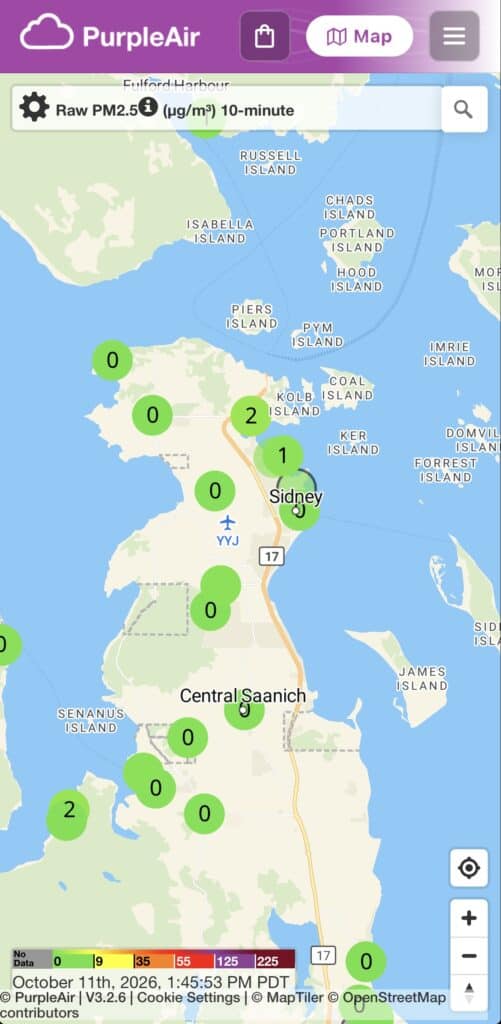
There are 6 sensors throughout North Saanich, an additional 4 in Sidney, 6 in Central Saanich, and many in Victoria and beyond. Three of the sensors in North Saanich are run by the Municipality of North Saanich (link here) and are located at the Municipal Hall on Mills Road, and the two fire departments on Wain and McTavish Roads. These sensors monitor the problematic particulate pollution in real time, specifically the 1-micron (PM1), 2.5-micron (PM2.5), and 10-micron (PM10) particles that travel deepest into the lungs. I chose raw PM2.5 as the unit for the screenshot above, and while the values can be read directly from each circle, the colours provide instant information: Green means excellent air quality, whereas yellow to orange to red to purple are progressively worse or downright terrible. Since air quality can be very local, having access to multiple sensors around the peninsula is more informative.
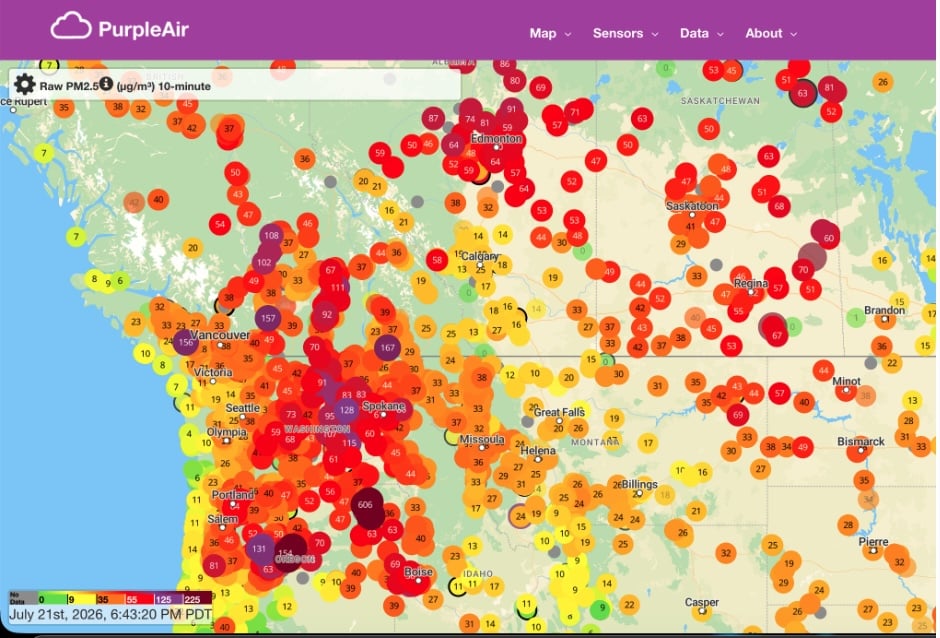
In the summer of 2026, BC had some of the worst air quality on the planet due to wildfires, and the Purple Air map, above, shown for July 21, 2026 , reflects the widespread PM2.5 particulate pollution. These Purple Air sensors have been tested by the BC Government (link here) and are a valid and inexpensive means of determining particulate air pollution. We have noted that in addition to summer wildfires, poor air quality is also observed locally on burn days when the BC Ventilation Index, found on the North Saanich Fire Hall website, is poor, causing the smoke to linger. In addition, on some days in winter, meteorological inversion layers set up, trapping smoke from wood stoves and causing locally poor air quality.
The Purple Air monitors provide a host of additional information that you can freely access such as temperature, humidity, and others. If you click on a specific monitor, it will provide the trace of pollutants over time over the past 24+ hours, so you can view fluctuations. The units can also be changed easily, to the Environment Canada AQHI index, or as I like to see, the raw PM2.5 values in real time.
What do you do if air quality is poor? We regularly notice people running and biking on days with poor air quality wearing good quality tight-fitting N95 masks, but for your home, you might consider an air purifier. Not all devices are the same, or even worth your money, so do your homework. A good place to learn more is the website HouseFresh, an independent website run by engineers in Quebec who actually test air purifiers and provide the data (plots of decay curves) against particulate pollutants. Particulate pollutants also include viral aerosols, so these air cleaners also protect against respiratory viruses like COVID, influenza, and RSV, among many other airborne pathogens. A simple and highly effective do-it-yourself air purifier is called the Corsi-Rosenthal cube (and its many variants), which you can build for less than $100 in 30 minutes using materials from our local Canadian Tire: Pick up some duct tape, 1-4 MERV13 (Filtrete 1900 or higher) furnace filters, and a box fan. Over time the filters can get quite dirty during wildfire season, which is certainly preferable than your lungs!
References and additional information
Lancet Commission on Pollution and Health: Link
Article on Lancet quoted in paragraph one: Link
Research by the EPA on DIY Corsi-Rosenthal Air Cleaners: Link
House Fresh Testing of Air Purifiers: Link
How to Build a Corsi-Rosenthal Cube Box: Link
House Fresh Testing Site of Air Purifiers: Link
House Fresh Testing Specifically for Wildfire Smoke: Link